K-pop
How to Keep Up With Korean Slang and Trends (거제 야호)
Korean slang and trends move overnight — 거제 야호 is the proof. Here's how to keep up, where ChatGPT helps, and where a trend-aware speaking partner picks up.
If you study Korean, you have had this moment. Your bias keeps shouting something in a video, the comments are full of it, everyone is doing the same little hand gesture, and you have no idea what it means or why it is funny. You feel like the one person at the party who missed the joke.
Right now, that joke is 거제 야호.
What does "거제 야호" (Geoje Yaho) mean and where did it come from?
거제 야호 is a K-pop catchphrase that went viral in May 2026. The short version: 거제 (Geoje) is a place — an island city in the south of Korea — and 야호 (from the Japanese やっほー) is a casual young-person greeting, roughly "hey" or "hello." Put together and shouted, "거제~ 야호~!" is basically a cheerful "Geoje, helloooo!"
The origin is what makes it land. It started on the personal YouTube channel of Woni, the leader of the girl group RESCENE. In one episode, Japanese member Minami appeared in a gyaru concept — a loud, playful Japanese street-fashion style — and shouted "거제~ 야호~!" Geoje happens to be Woni's hometown. The clash of a polished idol with folksy regional energy and full gyaru attitude was unexpectedly funny, and it took off across YouTube and Instagram short-form.
From there it became a format. You keep the structure and swap 거제 for any place or person: "○○~ 야호~!" — paired with a downward "gyaru peace sign" gesture. Other idols joined in, including NMIXX's Sullyoon, izna, H1-KEY, and I.O.I.
And it had real-world weight, which is the part that surprises people. All five RESCENE members were appointed Geoje City promotional ambassadors. Their two-year-old song "LOVE ATTACK" re-charted on the strength of the meme, re-entering Melon's Top 100 and climbing all the way into the Top 10. Short-form clips of the members went viral, and Geoje's tourist spots saw a real bump in interest.
If you are reading this six months from now, 거제 야호 may already feel like ancient history. That is not a flaw in this example — it is the entire point.
Why does Korean slang change so fast — and why don't textbooks keep up?
거제 야호 is a perfect specimen of a much bigger pattern: Korean slang moves overnight. A phrase can go from nowhere to everywhere in days, and feel dated just as fast. Think of 럭키비키 (Lucky Vicky, born from IVE's Wonyoung), 갓생 (god-life, the productive-living flex), or 갑분싸 for a conversation that suddenly goes cold. By the time any of these makes it into a printed textbook, the internet has usually moved on.
This is why study material is structurally bad at slang. Textbooks are built for the stable core — grammar, polite endings, vocabulary that will still be true in ten years. That is the right job for a textbook. But culture in real time is not on its schedule. The same is true of anything with a frozen knowledge cutoff: it knows the Korean of a year ago, not the Korean of this week.
Here is the thing worth internalizing. The hard, under-served part of Korean was never the writing system. Hangul is famously one of the easiest alphabets in the world — you can learn it in an afternoon. The difficulty lives elsewhere: the U.S. Foreign Service Institute files Korean as a Category V "super-hard" language, roughly 2,200 class hours to reach professional proficiency, in the same tier as Arabic and Mandarin. Most of that difficulty is grammar and speaking — and speaking currently, about what people are actually talking about, is the layer almost nothing teaches. It is the same reason the Korean most fans want is conversational, not the kind TOPIK measures.
How do K-pop fans actually keep up with new Korean slang?
There is no textbook for this, but there is a system, and fans who stay current all use some version of it. Slang lives where native speakers actually post. So you go there:
- Korean TikTok, Instagram, and X. Follow Korean accounts, not just translation accounts — the comments are where slang is born and used in the wild.
- Comment sections. Top replies under a music video are a live dictionary of whatever phrase is current.
- Variety shows. Running Man, Knowing Bros, and their cousins are slang firehoses, all in exactly the casual register you want.
- Fan communities. A good forum or subreddit will explain a new meme within hours, with context a dictionary would miss.
None of this is homework. It is the stuff you would scroll anyway, pointed slightly more deliberately. And the emotional payoff is real: instead of being the person who missed the joke, you start being the person who gets the in-joke your faves keep referencing — and even gets why it is funny.
That is also the fastest motivation engine there is. The fans who improve quickest are the ones who turn the songs and shows they already love into Korean they can actually use, because caring about the content does the hardest part of language learning for free: it makes you want to understand.
Can ChatGPT keep up with the latest Korean slang and idol trends?
This is where a lot of learners reach for ChatGPT, so let's be fair about what it does and doesn't do.
Full disclosure: we make Sudamate, a Korean speaking app, so we think about this question for a living and we are obviously biased. That also means we have looked hard at ChatGPT — and it is genuinely excellent at the evergreen text layer. Grammar explanations, vocabulary, example sentences, rewriting your stiff paragraph, drilling a verb ending until it sticks. It is endlessly patient and a safe, private place to be wrong. For that work, it is hard to beat, and we tell our own users to keep it open for exactly that.
It is also worth correcting a common myth: ChatGPT does have web browsing now. If you ask it directly, "what does 거제 야호 mean?", it can go look. So the honest gap is not that it is incapable of finding current information.
The gap is behavioral, and it is by design. ChatGPT is a general-purpose assistant that is reactive and text-first. In the flow of a conversation it leans on its training data, and it won't proactively bring up this week's meme or weave a fresh trend into casual banter the way a friend would. It waits to be asked. It also won't reliably hold a natural casual register without prompting — its default Korean skews textbook-ish, 당신 too formal, 너 too casual — and it forgets you between sessions, so you re-engineer the same "be my Korean friend, reply only in Korean, keep it short" prompt every time. We went deep on the speaking side of this — pronunciation, memory, register — in our companion breakdown of practicing Korean with ChatGPT.
From knowing the slang to saying it out loud
Notice the quiet jump we just made. Everything above — looking up 거제 야호, reading the comments, asking ChatGPT to explain a phrase — builds knowledge on the page. But knowing slang and being able to use it in a real conversation are two different skills, and the second is the one almost nothing trains.
You know the feeling. You understand the meme perfectly. Then a Korean speaker actually says it to you, grins, and waits for your reaction — and your mind goes blank. The words are in there somewhere; they just will not come out in time. Reading is asynchronous and forgiving. Talking is real-time and merciless.
That freeze is normal and beatable, but only with reps — saying the awkward first sentence out loud, often, somewhere it is safe to fumble. We wrote a whole guide on getting unstuck and saying the first sentence when you usually freeze, because this is the wall most learners hit long after they have the vocabulary.
What's next: a Korean partner that's actually in the loop
So here is the honest division of labor we have landed on, and it is the whole reason Sudamate exists.
Keep ChatGPT for the fundamentals — the grammar you are untangling, the vocabulary you are collecting, the message you want to check before you send it. That layer is well served, and it does not need us.
Use Sudamate for the living, current, in-the-loop part: actually talking. It is a voice-first Korean speaking app, and its tutor has a web-search tool wired in. The interesting bit is when it fires. It doesn't wait for "please look this up." If you so much as mention something time-sensitive in passing — an idol's comeback, the 거제 야호 meme, "어제 T1 경기 진짜 재밌었어요" about last night's match — it pulls current context and then replies about it in natural, casual Korean, out loud. In other words, it behaves like a Korean friend who happens to be online and up to date, not a general assistant waiting to be queried.
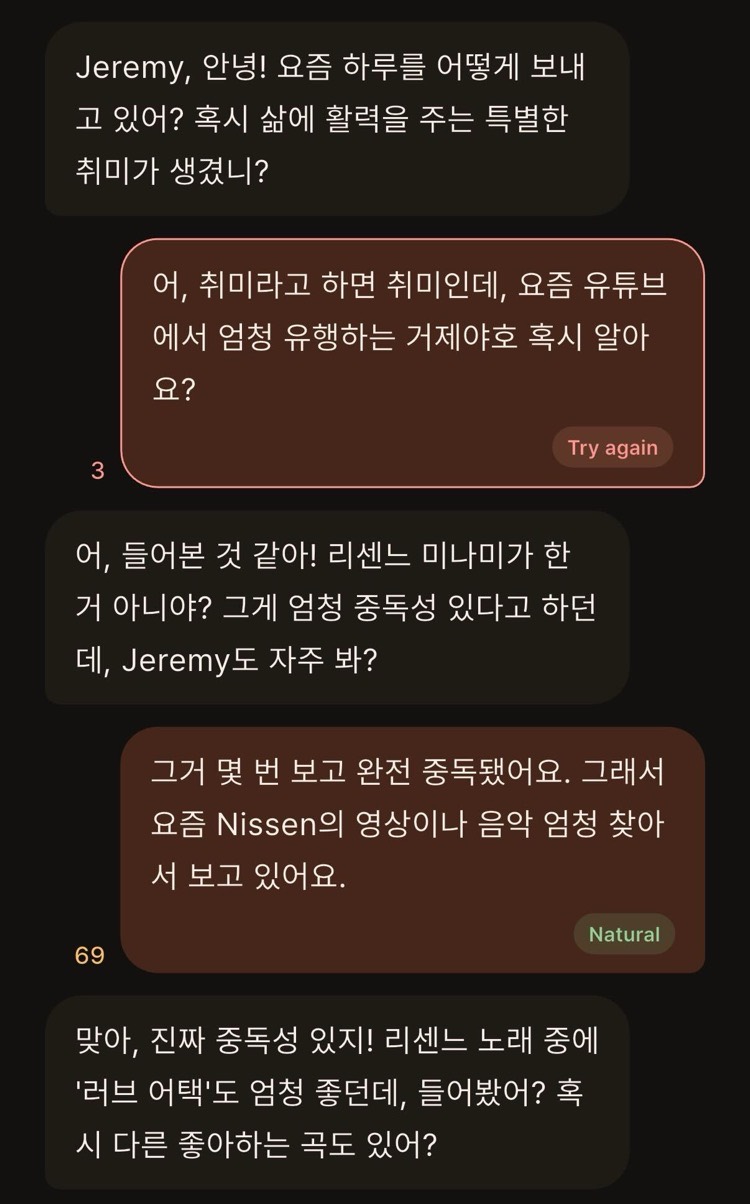
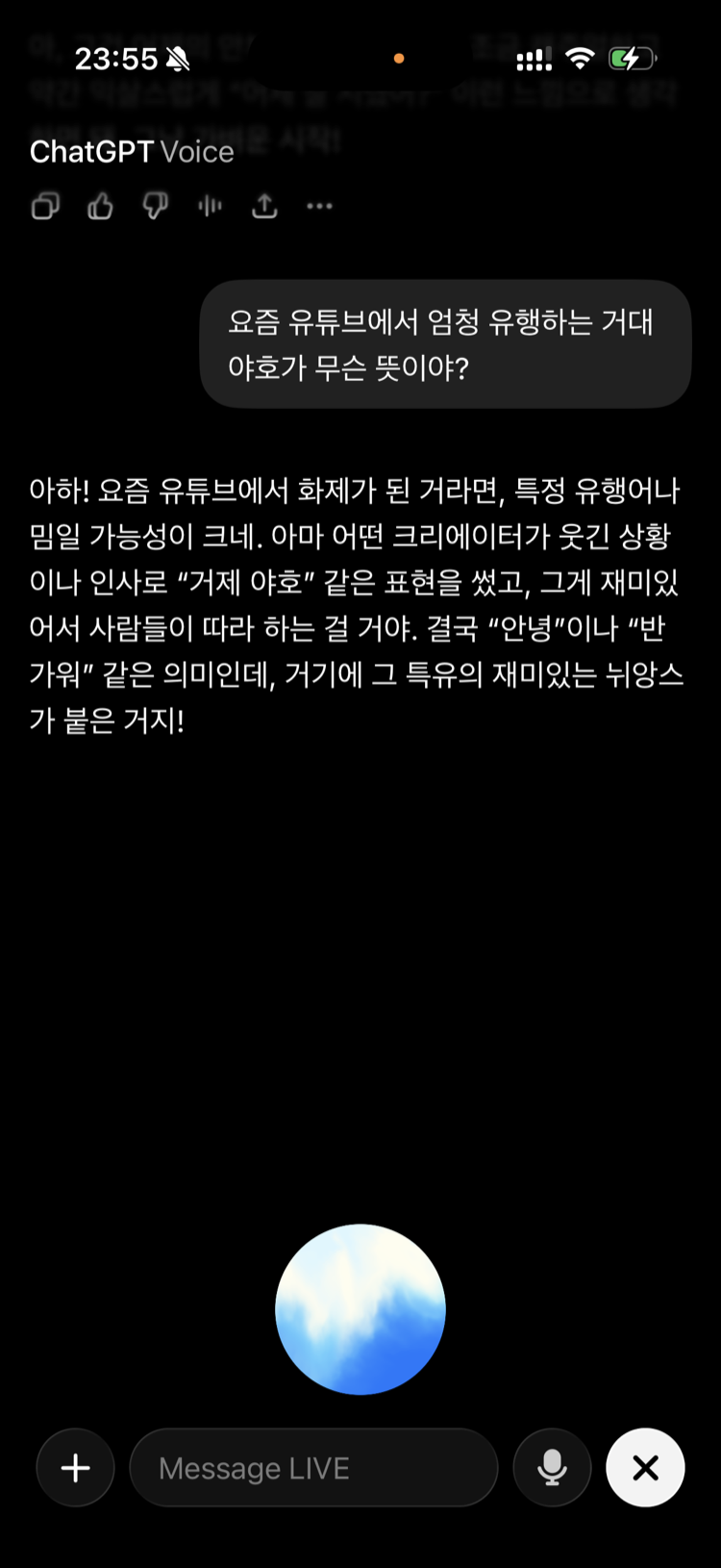
We want to be precise here, because overclaiming would be the easy lie. Sudamate is not an omniscient meme database, and it won't always have the freshest in-joke locked. What it is built to be is a partner where today's K-culture — the comeback, the match, the phrase everyone is shouting — pulls more Korean out of your mouth, instead of a coffee-ordering roleplay you force yourself through. If you want the fuller picture of what it is and who it is for, we wrote a plain explainer of what Sudamate is.
Slang will keep moving overnight; that will never stop. The goal was never to memorize a list before it goes stale. It is to stay close enough to living Korean — and to practice speaking it often enough — that the next 거제 야호 is just another joke you get, and can actually say back.
Frequently asked
- What does '거제 야호' (Geoje Yaho) mean?
- It's a viral May 2026 K-pop catchphrase. It started when RESCENE's Japanese member Minami, in a gyaru concept on leader Woni's personal YouTube channel, shouted '거제~ 야호~!' — 거제 (Geoje) is Woni's hometown and 야호 (from Japanese やっほー) is a casual young-person greeting, roughly 'hey' or 'hello.' The funny clash of a polished idol with folksy regional energy made it spread, and the format became '○○ 야호!' — swap in any place or name, paired with a downward gyaru-peace gesture.
- Who started the 거제 야호 trend and which idols joined it?
- It originated on RESCENE leader Woni's self-produced YouTube content featuring member Minami, then spread across YouTube and Instagram short-form in May 2026. Other idols joined the challenge, including NMIXX's Sullyoon, izna, H1-KEY, and I.O.I. The trend was big enough that all five RESCENE members were appointed Geoje City promotional ambassadors, and their two-year-old song 'LOVE ATTACK' re-charted, climbing back into Melon's Top 10.
- Why does Korean slang change so fast, and why don't textbooks teach it?
- Korean internet and idol slang can go viral overnight and feel dated just weeks later, so by the time a textbook is printed the phrase has already moved on. Recent examples like 럭키비키 (Lucky Vicky) and 갓생 (god-life) live on TikTok, comment sections, and variety shows, not in study material. Textbooks are built for stable grammar and vocabulary — they're not designed to track culture in real time.
- Can ChatGPT keep up with the latest Korean slang and idol trends?
- Partly. ChatGPT does have web browsing, so it can look up a phrase like 거제 야호 if you ask it directly. But in normal conversation it leans on its training data and is reactive and text-first by design — it won't proactively bring up this week's meme or weave a fresh trend into casual banter the way a real friend would. It's excellent for grammar and vocabulary; staying conversationally in the loop on overnight trends is its weak spot.
- Can an AI Korean tutor talk about a new comeback or last night's match?
- Some can. Sudamate, our voice-first Korean speaking app, gives its tutor a web-search tool that triggers even when you only mention something time-sensitive in passing — an idol's comeback, a viral meme, last night's LCK match — then replies about it in natural, casual Korean. It's not an omniscient meme database, but it's built to behave like a Korean friend who's online and up to date, rather than a general assistant waiting to be asked.